




When an important email becomes part of a dispute, regularly used phrases like “I sent it” or “I received it” can mean very different things. A sent folder may show that a sender clicked Send, an email delivery receipt may indicate that a mail system accepted a message, email open tracking may record an interaction with the message, and an email read receipt may suggest that a recipient’s email client reported it as opened.
But none of those facts automatically proves all the others.
For legal, compliance, HR, finance, insurance, collections, government, and other regulated-business communications, the key is understanding four separate stages: sent, delivered, opened, and read. Each stage requires different email evidence, and some forms of email tracking evidence are much stronger than others.
An email has to move through several systems between the sender and recipient. The sender's email client typically sends the message to an SMTP server. From there, SMTP routes the message toward the recipient mail server and/or potentially through other servers along the way. Email headers can contain routing information, timestamps, Message-ID data, and “Received” fields documenting parts of that journey.
These SMTP handoffs between mail transfer agents are often considered as part of the message's delivery path and can provide an audit trail. What this means is that proof email was sent and proof of email delivery are different questions.
Under the UETA framework as well, sending is associated with the electronic record leaving the sender-controlled environment, while receipt can occur when the record enters the information-processing system designated or used by the recipient. Importantly, receipt does not necessarily require an individual to know that the message arrived.
That distinction becomes important whenever a deadline, notice, payment demand, policy communication, claim, or other consequential message is challenged.
Many organizations assume the Sent folder provides proof an email was sent. It’s useful evidence, but it has limitations. A Sent-folder record generally shows what the sender's email application recorded. Similarly, automatically BCCing yourself, creating a PDF, or archiving the outgoing message shows what existed within systems under the sender's control.
However, these only show that the message actually left the sender's environment; it doesn’t prove that the message was delivered with certainty in the recipient’s inbox. Ordinary email records can be edited, making a saved copy useful for business records but potentially weaker when authenticity is challenged.
Better proof of sending email can include:
So, if you ask, “Do I have a copy?” it won’t necessarily prove anything. You must ask: “Can I establish that this particular message, with this content, entered a system outside my control at this time?”
Delivery is another step. A technically meaningful delivery receipt should establish that the destination infrastructure accepted the message for the recipient. In many cases, that means acceptance by the designated receiving mail server.
This should not be confused with seeing the message inside the recipient's visible inbox. After SMTP acceptance, filtering rules, spam controls, forwarding, quarantine systems, or mailbox policies may still affect what happens inside the recipient's environment.
A lack of a bounce message is also not necessarily proof that an email was delivered. Bounce behavior varies between systems, and a message can initially be accepted and later generate a delivery-status notification indicating a problem. For stronger proof of email delivery, look for evidence of recipient-server acceptance, delivery status, timestamps, and any subsequent delivery record.
There is another important distinction: a basic delivery confirmation might establish that an email transaction occurred without establishing exactly what message content and attachments were delivered.
An open is different from a delivery. Email open tracking frequently relies on a small remote image or tracking pixel. When that resource is requested, the sender's system may record an open event. That creates email open evidence, but the evidence needs context. Automated security scanners, image proxies, privacy systems, caching, and other technologies can sometimes trigger or obscure open activity.
So, an open event is generally better interpreted as an interaction associated with a message. It should not automatically be interpreted as: “This specific person personally opened and reviewed this email.” For consequential communications, open information can be useful additional evidence, but it should not replace reliable email delivery tracking.
This is where terminology becomes especially important. A traditional read receipt normally depends on the recipient's mail application and settings. The recipient may allow receipts automatically, decline them, or configure the system to never return them.
Receiving an Outlook-style email read receipt does not establish the precise content associated with the transaction, while failure to receive one does not mean that the message was not read. More fundamentally, opening is not the same as reading.
Someone might open an email and immediately close it. A security system might load the content automatically. Even an explicit acknowledgment demonstrates an action, which does not necessarily mean that every sentence and attachment was understood.
Email authentication deserves its own distinction. SPF, DKIM, and DMARC help establish whether email is authorized and protect against spoofing; they are important security controls, but they are not themselves proof of receipt or proof that a particular recipient received or opened a specific message.
For most business purposes, it is therefore better to prove objective events such as sending, delivery, content, opening, acknowledgment, or sign-off rather than claim that technology can prove a person's mental act of reading.
| Evidence | What it can establish | Key limitation |
| Sent folder / archived copy | What the sender's system recorded | Does not independently prove external transmission or delivery |
| SMTP/server logs | Transmission and server activity | Must be connected to the correct message, recipient, content, and timestamps |
| Email headers / Message-ID | Routing and message metadata | May provide only part of the overall evidence record |
| Delivery receipt | Server acceptance or delivery status | May not prove precise content delivered |
| No bounce received | Very limited evidence | Absence of a bounce is not reliable delivery confirmation |
| Tracking pixel/open event | Possible message interaction | Does not necessarily identify a human reader |
| Email read receipt | Recipient-client response | Can be declined or disabled and does not prove comprehension |
| Verifiable delivery + content record | Sending, delivery, content, and timing | Requires technology designed to preserve these elements together |
For ordinary correspondence, standard email records may be enough. The requirements change when organizations send termination notices, payment demands, insurance communications, tax notices, contractual notices, regulatory communications, HR documents, legal correspondence, or other time-sensitive records.
In those situations, businesses may need to establish:
That is a substantially higher standard than requesting an email read receipt.
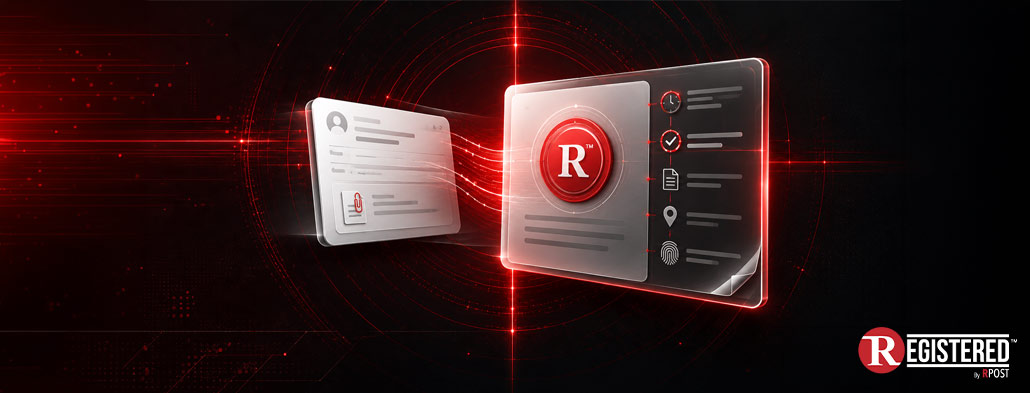
RPost's Registered Email™ service is designed around this distinction between ordinary tracking and verifiable evidence. For each Registered Email transaction, the Registered Receipt™ provides a record that can include the official time of sending, delivery status and time, recipient information, message content, attachments, delivery metadata, and related forensic information.
The receipt is a self-contained, durable record that can reconstruct the original message and authenticate the associated content and transaction data. It also accounts for subsequent delivery-status information that could contradict an earlier server acceptance.
The practical difference is important: email tracking evidence tells you what appears to have happened. A stronger evidence record connects what happened to the exact message, content, recipient, and time, and preserves the information so it can later be authenticated.
For organizations where an email may eventually become evidence, that distinction can matter far more than whether a read-receipt checkbox was selected.
September 25, 2026
September 04, 2026

July 17, 2026

July 01, 2026
June 09, 2026





 Blog
Blog