



Most business emails, such as a quick project update, meeting follow-up, or routine question, don’t need special proof or evidence. Rather, they can usually be handled with regular email. But some messages carry more weight. For instance, a deadline may depend on when a notice was delivered, or a customer may later dispute what was sent. In such situations, simply having a copy in your Sent folder may not provide the email proof you actually need.
This is where certified email becomes useful. It broadly refers to email services designed to create verifiable evidence of an electronic message, including evidence of message delivery, content, and time.
Regular email is built for communication - you compose a message, click Send, and usually assume it reached the recipient, unless something happens. The problem is that several common email records do not necessarily prove the complete transaction.
A copy in your Sent folder shows what is stored or sent from your own system. An electronic message may not be considered sent until it has moved beyond a system controlled by the sender. A sender-controlled archive therefore does not, by itself, establish when the message left the sender's control.
Likewise, not receiving a bounce message does not necessarily prove successful delivery. Email administrators may configure systems to not return certain rejection notices, so “zero bounce email” from the recipient's mail system should not automatically be interpreted as confirmation.
Even email read receipts have limitations. They depend on the recipient's email software and settings, and recipients can configure their systems not to return them. More importantly, a standard read receipt does not establish the exact content associated with the delivery event.
Certified email is intended to address this evidence gap by creating a more complete record of the communication.
The rule is simple: the greater the consequence of a disputed message, the stronger the case for certified email. Here are the situations where it’s relevant:
Sometimes proving that an email was delivered is not enough; you may also need to establish exactly what was sent to the recipient.
A mail server can confirm acceptance of a message without that confirmation independently proving the email body or attachments that were included with it. Here, proof of receipt is distinctly different from proof of the content received.
This matters for an important business email containing items such as contractual information, approvals, policy changes, financial instructions, formal correspondence, or supporting documents.
Time is important when communications involve deadlines, renewals, notices, or other time-dependent obligations. There is again a distinction between the time a sender clicks Send, the time a message leaves the sender's environment, and the time it reaches the recipient's designated mail system.
For regular communications, that distinction may have little practical impact. But when someone later asks, "Was the notice delivered before the deadline?" a timestamped delivery record can become much more important.
Legal notices are one of the clearest examples of when stronger evidence may be valuable. Let’s explain by taking the example of a law firm receiving permission to serve parties electronically.
That does not mean email automatically satisfies every legal notice requirement. The applicable rules, required consent, contracts, and jurisdiction still matter. But where electronic delivery is permitted, a verifiable record can provide more support than an ordinary Sent item or read receipt.
Organizations in regulated industries often need more than operational convenience. They may need records that demonstrate communications and controls can be verified later.
That makes certified email more relevant to compliance email when an organization needs to demonstrate not simply that an employee remembers sending something, but that there is an auditable record associated with the transaction.
The same principle applies to governance and risk teams, which often need defensible audit trails showing that controls were applied and communications occurred as required.
Consider a customer, supplier, employee, policyholder, or other business party saying: "I never received that" or "That's not what you sent me."
For an everyday conversation, the dispute may be easy to resolve. For a contract notice, policy change, payment-related communication, renewal, termination, or other high-consequence message, it can become a serious business issue.
Regular email records may show what the sender claims to have sent, but the stored email and printed or PDF copies can be edited and do not necessarily establish the content actually delivered to the recipient. A certified email record is intended to give the sender stronger evidence when those questions arise.
Certified email should not replace every email. Regular email remains appropriate when the communication is routine, easily repeated, low risk, and unlikely to require formal evidence later. Internal conversations, scheduling, general updates, informal questions, and everyday collaboration usually fall into this category.
The distinction is less about whether a message is "important" and more about what happens if someone disputes it later. If nothing significant depends on proving delivery, content, or timing, regular email may be sufficient. If money, deadlines, compliance obligations, contractual rights, or legal consequences depend on that evidence, certified email deserves consideration.
The difference between regular email vs. certified email becomes clearest after asking one question: If this message is challenged six months from now, what would you need to prove? And if you think that, "I sent an email and it’s there in my Sent folder," it’s not enough.
If you need evidence of what was sent, when it was sent, whether it was delivered, and what content accompanied that delivery, ordinary email tools may leave gaps. Standard read receipts, delivery notifications, archives, and copied messages each provide only part of that picture.
For those higher-consequence communications, certified email provides a way to treat email not merely as a conversation, but as a transaction with a verifiable record.
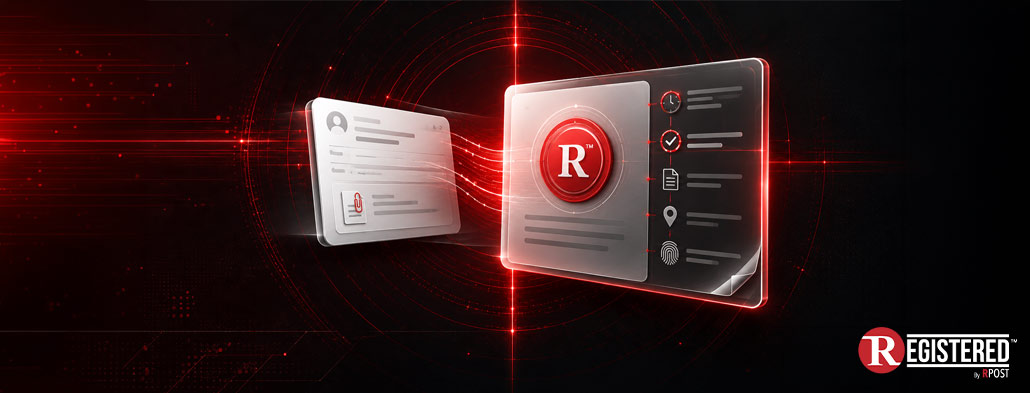
RPost’s Registered Email™ service helps create irrefutable evidence of the time of sending, time of delivery, and precise content delivered. The resulting Registered Receipt™ is a self-contained record capable of reconstructing the original message content, attachments, and transaction metadata.
September 25, 2026
September 04, 2026

July 17, 2026

July 01, 2026
June 09, 2026





 Blog
Blog