





Are email open tracking and delivery tracking the same? Sending an email and knowing what happened next are two different things. Email open tracking can indicate that someone viewed or interacted with the message, while delivery tracking records whether the message reached the recipient and was accepted by the recipient’s email system.
One isn’t preferred over another, but both answer different questions. Choosing an email with tracking depends on whether you need engagement visibility, operational confirmation, or stronger proof of delivery.
Email open tracking records an event of an email being opened. It is commonly used in sales, marketing, collections, customer service, and other workflows where the sender wants to know whether the recipient has interacted with the message.
When the email client loads the image, the tracking system records information such as the time of opening. Open tracking can help answer questions such as whether there was any activity at the recipient’s end, the time of the first open, whether the message was opened more than once, and whether the sender should follow up.
However, an open event does not necessarily prove that the intended recipient personally read the message.
Some email clients block external images, which prevents a tracking pixel from loading and, in turn, limits the sender’s ability to detect when an email is opened.
Email security systems also inspect messages, attachments, images, and links before or after delivery. Such controls can include scanning, filtering, quarantining, rejecting, or re-evaluating messages as part of enterprise email security. These automated processes can create activity that needs to be distinguished from a human interaction.
An open record should therefore be treated as an interaction signal. It may support follow-up decisions, though it should not be the only evidence used when a message carries legal, contractual, or compliance consequences.
Email delivery tracking records what happened while the message was being transferred between email systems. A delivery record may show that the receiving mail server accepted the email, temporarily deferred it, rejected it, reported an invalid address, or returned a delivery failure later.
Delivery tracking focuses on the email transaction rather than the recipient’s later behavior. A delivered status usually means that the receiving system will process the message, which may subsequently be placed in the inbox, routed to spam, held for review, archived, or managed according to the recipient organization’s internal policies.
An important thing to note here is that the absence of a bounce message should not automatically be treated as proof that an email was delivered. Some servers suppress bounce notices, while others may initially accept a message and return a failure later.
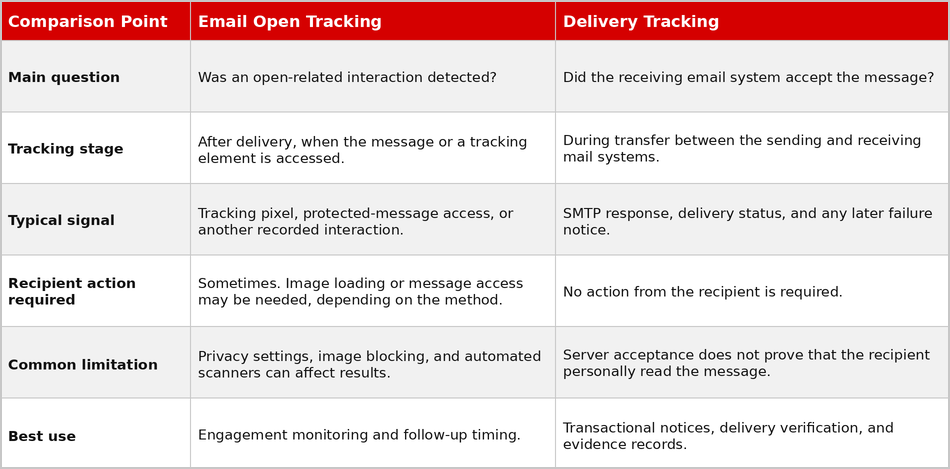
The two records can complement each other. Delivery tracking establishes whether the message reached the recipient’s system, while open tracking provides additional visibility into what may have happened later.
The read receipt vs tracking distinction is also worth understanding.
A standard read receipt is usually a request sent through an email program such as Outlook. Whether the sender receives it, can depend on the recipient’s email client, organization settings, and decision to approve or reject the request.
The recipients may configure their systems to return read receipts automatically, ask for permission, or never return them. A read receipt also may not prove the exact message body or attachments associated with the event.
Open tracking generally works without asking the recipient to manually approve a receipt. It can provide better engagement visibility, though its accuracy still depends on the method used and the recipient’s technical environment.
Proof of delivery is needed in situations involving routine sales or marketing emails, where an open signal may be enough to guide a follow-up.
However, for contract notices, payment demands, policy communications, insurance notices, HR correspondence, regulatory messages, or dispute-sensitive emails, the sender may need a complete evidence record.
Stronger proof of delivery should contain several elements:
A server response showing delivery does not automatically prove what content was delivered. A sent-folder copy also shows only what remains in the sender’s own system. A holistic proof of delivery system must preserve delivery information together with the message content, attachments, timestamps, and transaction metadata.
The Registered Email™ service by RPost combines delivery tracking and email open tracking within a broader transaction record. The service’s open reports include delivery and open timestamps, while the Registered Receipt™ contains SMTP delivery information, open records, and options to authenticate and reproduce the original message.
This approach is more useful when the sender needs visibility into engagement and a record of what was sent and delivered.
The practical difference is simple: delivery tracking records the email’s arrival at the receiving system, while open tracking records a later interaction signal. For consequential communications, the stronger record connects delivery, content, timestamps, attachments, and available open information in one verifiable audit trail.
October 26, 2026
September 25, 2026
September 04, 2026
July 17, 2026

July 01, 2026





 Blog
Blog