



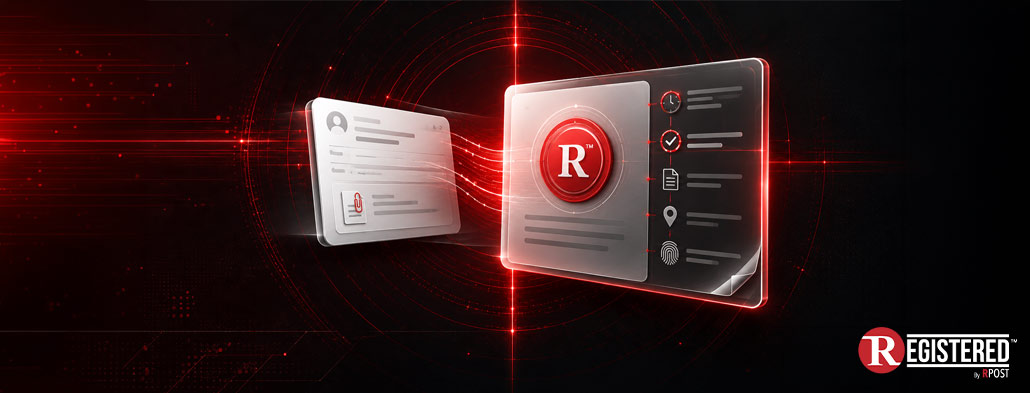
Most business emails, such as a quick project update, meeting follow-up, or routine question, don’t need special proof or evidence. Rather, they can usually be handled with regular email. But some messages carry more weight. For instance, a deadline may depend on when a notice was delivered, or a customer may later dispute what was sent. In such situations, simply having a copy in your Sent folder may not provide the email proof you actually need.
When an important email becomes part of a dispute, regularly used phrases like “I sent it” or “I received it” can mean very different things. A sent folder may show that a sender clicked Send, an email delivery receipt may indicate that a mail system accepted a message, email open tracking may record an interaction with the message, and an email read receipt may suggest that a recipient’s email client reported it as opened.

Armand here, RPost’s product evangelist armadillo. Since I am apolitical, I thought I would opine on only the technology that DOGE appears to be using via the US Office of Personnel Management (OPM) to send notices to Federal employees across various departments, agencies and entities, and common misconceptions related to email delivery.

The $100 million “Hermès” Registered Email™ Message (& CLE Webinar That Tells More) What a deal! My favorite functional yachting sportswear at 70% off! Or so I thought. Nearly every successful product brand is facing a strange new competitor — their own “fake” self. Let me explain how this plays out.

A Messi Situation: $800 Million Fax Misses Deadline, Should Have Used Email E-Delivery Proof Soccer/Futbol superstar, Lionel Messi, longed for a transfer after a humiliating Champions League knock out loss to Bayern Munich. Where to go from here? Paris? Manchester? Luckily, he built in a back-door exit clause in his contract where, if he notified […]
September 25, 2026
September 04, 2026

July 17, 2026

July 01, 2026
June 09, 2026