




Standard email works well for everyday communication as it’s fast, familiar, and easy to send from tools (Outlook, Gmail, etc.) that people already use. The challenge comes when the email is later used as evidence.
We see so many scenarios play out in real-life - a customer says they never received a policy notice, a vendor disputes a payment demand, an employee claims an HR notice was never sent, or a client says the attachment was different from what they remember sending. In such moments, a sent folder, read receipt, or screenshot may not be enough.
All of this may show what someone thinks they sent, or what their own system saved, but they may not prove the full trail of what transpired: who sent what, when it was sent, when it was delivered, and what content was delivered. That is the role of registered email.
Registered email is a method of sending email that creates a verifiable record of the transaction. In plain terms, it gives the sender proof of an important message. Depending on the service and configuration, that proof can include sending, delivery, timestamps, message content, attachments, and open data where available.
A registered email is different from a normal email because the evidence is built right into the sending process. The sender is not relying only on a sent item, an archive copy, or the recipient’s settings.
For business users, the point is simple: when an email has legal, financial, compliance, or operational consequences, the sender needs more than just “We sent the email.”
A sent folder is useful for day-to-day reference, but it’s weak as business email proof. It may show what your system saved, but it doesn’t show that the email left your email system, reached the recipient’s server, or included the same content the recipient later received.
An email archive has a similar limitation. Many archives store a copy of a message as it passes through the sender’s own infrastructure, which may prove useful for retention, but it is still only part of the picture. It does not automatically prove legal sending, delivery, or delivered content.
CC’ing yourself does not solve the problem either. A BCC or CC copy may prove the message reached your own mailbox, but it does not prove the message reached all external recipients.
Printing an email is also fraught with risk, as email content can often be edited, saved, forwarded, annotated, or printed after changes. A PDF may help someone remember what they handled, but it may not satisfy a dispute where the other side claims the message was altered or the attachment was missing.
Let’s deep dive more to understand the intricacies of Registered email by comparing it with read receipts. Read receipts are often confused with proof of delivery, but they are not the same.
A read receipt depends heavily on the recipient’s email software and settings. The recipient may block read receipts, ignore the email, use a system that does not return them, or have an admin policy that changes how the emails behave.
Even when a read receipt comes back, it may not prove the message content. It may show that some form of the email was opened or acknowledged, but it does not usually preserve a complete, verifiable record of the body, attachments, and transmission details.
For low-risk messages, a read receipt may be fine. But for legal notices, contract notices, HR notices, insurance communications, compliance alerts, or payment demands, it is usually too thin.
Postal registered mail and certified mail are physical in nature. They can help prove mailing or delivery of an envelope, but they may not prove what was inside the envelope. Registered email is designed for the email environment, as it can document the electronic message transaction and preserve proof of the message body and attachments.
That distinction matters because many business notices now move through email. Contracts, invoices, policy updates, HR letters, claim notices, renewal reminders, and customer dispute communications often start and end in the inbox. The proof system needs to match how the business actually communicates.
The process is similar to a regular email – composing the message, adding recipients and attachments, and sending it from email clients like Outlook, Gmail, Salesforce, or through API workflows, depending on how the business has deployed the service.
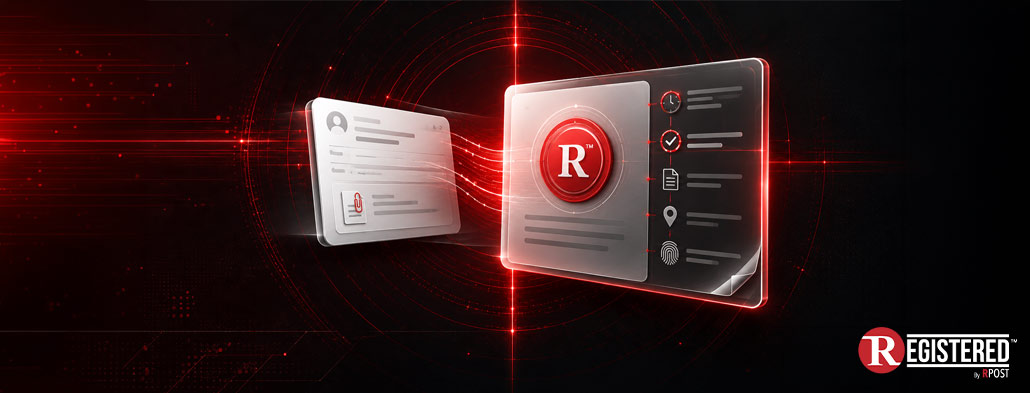
Some services like RPost Registered Email™ offer a Registered Receipt™ record that shows details that a standard email can’t provide, like a durable, self-contained, and self-authenticating proof record of the entire email transaction, including the original email, attachments, and transaction metadata.
This matters to businesses because email delivery is more technical than many business users assume. Clicking send inside Outlook or Gmail does not automatically prove legal sending. Similarly, a message sitting in your own mail server, archive, or sent folder may still be inside systems under your control. For stronger evidence, the record needs to show what happened beyond the sender’s own environment.
RPost’s Registered Email record creates a stronger audit trail in four areas.
Proof depends on trust in the sender and the record. Sender authentication helps reduce questions around whether the message came from the claimed sender, whether it was handled through an authorized service, or whether the evidence record can be validated later. This is especially relevant when email is used for legal proof, compliance, and customer-facing notices. If the sender’s identity is weak, the rest of the evidence may be harder to explain.
The proof problem and privacy problem are related, but they are not identical. A business may need to prove that an email was sent and delivered, as well as protect the content from improper access during transmission or after receipt.
For example, a benefits notice, insurance claim document, legal communication, or customer financial record may need both evidence and privacy controls. Registered Email can support the evidence side, while encryption and related controls can support confidentiality and compliance needs.
Email proof is becoming more important because business content keeps moving outside the sender’s direct control. Once an important message or attachment leaves the organization, it may be read, forwarded, stored, filtered, archived, scanned, or accessed through third-party systems. Security teams may have strong controls inside their own network, but usually have limited visibility into what happens after delivery.
This is one reason proof and content-level intelligence are becoming more connected. Businesses need to know that the right message was sent and delivered. In higher-risk workflows, they may also need better visibility into how sensitive content is accessed after it leaves the sender’s environment.
Registered Email addresses the evidence layer by documenting the communication record when timing, delivery, and content matter. Plus, it fits right into the existing tool stack of enterprises, like Outlook, Gmail, CRM workflows, case management tools, Salesforce, automated notices, or API-based systems. So, someone using RPost’s Registered Email service doesn’t need to change to another platform or tool to send a message.
This matters because the highest-risk emails often come from normal business workflows. A finance team sends a payment demand, the HR sends a notice, or the legal sends a contract update; if proof requires a separate manual process, people may skip it under deadline pressure.
Registered Email is best understood as a business email with a stronger evidence record. It does not replace good judgment, contract language, recipient consent, security controls, or legal review. It does solve a practical problem that shows up often - regular email is easy to send, but weak when someone later disputes delivery, timing, content, or receipt.
When proof matters, the question is not only whether the email was sent. The better question is whether the business can show who sent what, to whom, when, and with what result.
September 25, 2026

September 04, 2026

July 17, 2026

July 01, 2026
June 09, 2026





 Blog
Blog