




When an email carries legal, financial, contractual, or compliance weight, “I sent it” is rarely enough. A standard sent-folder copy, read receipt, or screenshot may not help you prove delivery, timing, or exact content if the recipient later says, “I never got it,” or “that was not what you sent.”
Certified email becomes important in such cases, creating a stronger evidence record around an email transaction. The goal is not just to send a certified email, but to prove who sent what, to whom, and when.
To showcase legal proof in an email, the strongest records usually need to show three things:
Certified email is an electronic delivery method that gives the sender proof of record for an important email. It is often used when the sender needs evidence that a message was sent, delivered, opened, or tied to specific content and timestamps.
In plain terms, instead of relying only on a postal signature, the sender gets a digital record showing the email transaction that is useful for legal notices, contract communications, policy updates, payment demands, insurance notices, HR notices, compliance alerts, client communications, regulatory correspondence, and more…
The key point here is that the normal email was built for communication, not legal evidence. A certified email service adds an evidence layer.
Many people assume their sent folder proves an email was delivered. But clicking the send button in Outlook or another email client can’t be considered as the legal time of sending. The message may still be inside the sender’s system, archive, server, or infrastructure. For stronger proof, the message needs to leave the sender’s control and enter an outside system or the recipient’s designated system.
There are also other weak spot scenarios, like:
This is why email proof of delivery should not rely on one fragile signal. Legal-grade email evidence needs a better chain of proof.
Sending a certified email for legal proof involves the following steps.
Step 1: Choose the Right Certified Email Method
Start with a service designed for legal proof, not just marketing email tracking. Marketing platforms can show opens and clicks, but they are not built to prove message content, delivery, and legally relevant timestamps.
An email service offering legal proof, such as Registered Email™, offers a cryptographic:
Step 2: Clear Draft
If the email is legally important, clarity matters. A certified email should not bury the key point in a long thread. It must include a direct subject line, the recipient’s correct email address, a clear statement of purpose, any deadline or required action, relevant attachments, and contact details for questions.
For example, instead of writing “Following up,” use a subject line like “Notice of Contract Termination – Response Required by June 15.” This holds better in a dispute.
Step 3: Attach the Correct Documents
Verify the attachments before sending. A certified email record is only as useful as the content it captures, so check for file names, file versions, signature pages, dates, supporting exhibits, recipient-specific documents, passwords, or encryption requirements.
This step matters because proof of delivery without proof of content can still leave room for argument. Because a mail server may confirm receipt, but that alone does not prove what content was inside the email or attachments.
Step 4: Send the Certified Email
With a Registered Email workflow, users can send from common email clients such as Outlook or Gmail by simply clicking the “Send Registered” button or automating sending through API or routing rules. And the recipient usually does not need special software, accounts, or extra steps. The message is delivered into their inbox like a normal email, while the sender receives the proof record.
Step 5: Save the Registered Receipt or Evidence Record
After sending, the sender gets an evidence record. Registered Email offers the Registered Receipt™ as the record returned to the sender with delivery proof, content proof, and an official timestamp.
A good evidence record helps reconstruct:
The Registered Receipt can reconstruct the original message content, attachments, and transaction metadata, irrefutably authenticating who said what to whom and when, by email. And it holds up in court!
Step 6: Review the Delivery Result
After the email has been sent, you must open the receipt and check the delivery status; whether the message was delivered, opened, delivery pending, delivery failed, delivery accepted, then later rejected, mailbox full, invalid address, or server rejection.
The last point matters specifically because a server may initially accept a message and later return a rejection.
A certified email is useful when it creates an evidence record that can be authenticated later. The value is not just “tracking,” but offering proof. A stronger certified email process records:
This brings us to the question: Are read receipts the same as certified email? No, they AREN’T.
A read receipt may tell you someone opened or viewed a message, but it often depends on the recipient’s email settings. The recipient can block it, ignore it, or use an email client that does not return it properly.
Certified email is different because it is designed to create a formal proof record. It focuses on the whole transaction, not just whether someone clicked or opened the email.
You should send a certified email when the email could later be questioned, denied, delayed, or disputed.
It’s useful for cases like legal notices, demand letters, breach notices, contract notices, lease notices, employment notices, insurance communications, settlement communications, regulatory notices, high-value business approvals, or time-sensitive instructions.
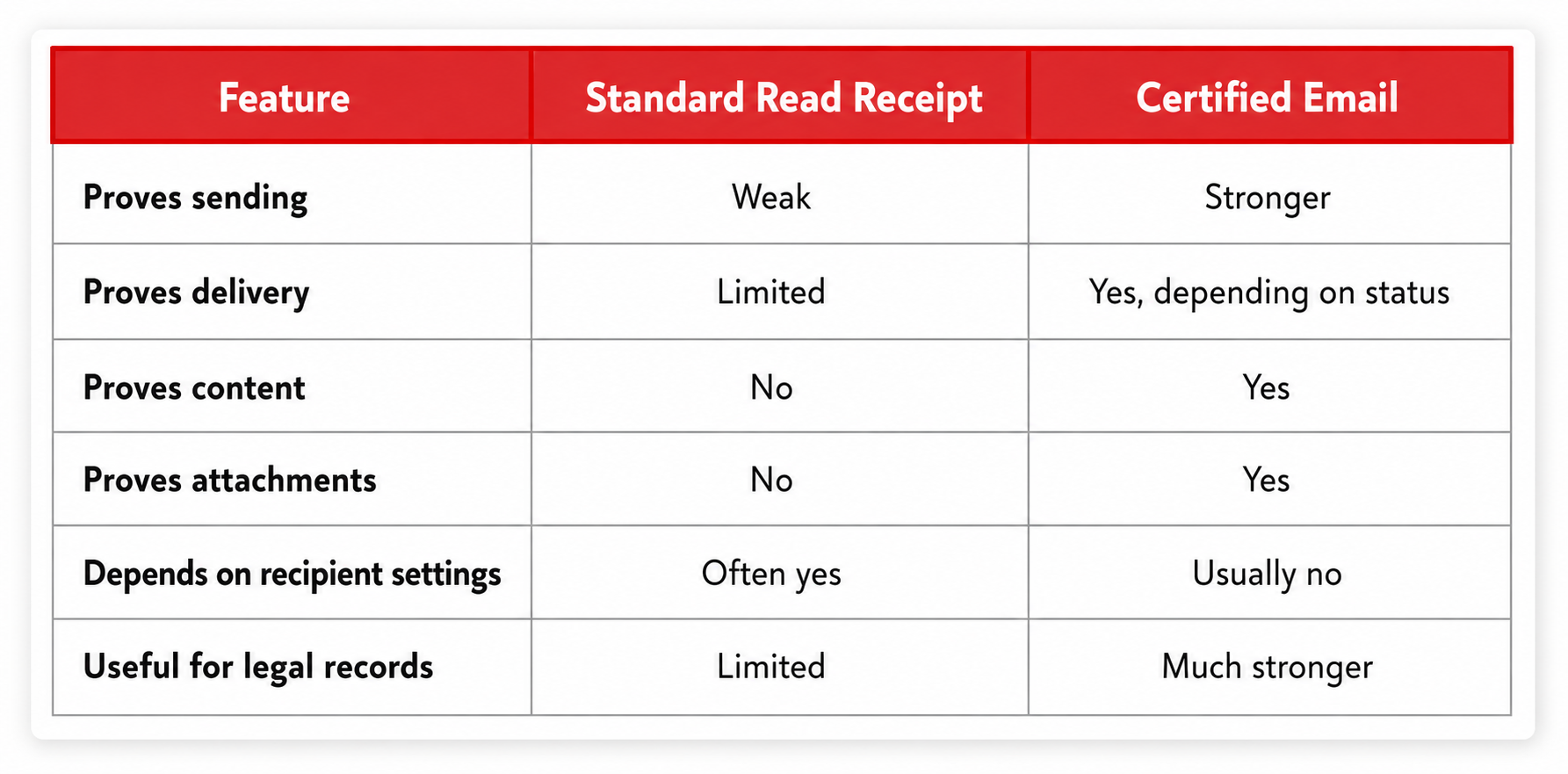
In short: when the email could cost money, rights, deadlines, or reputation, send it with proof.
Knowing how to send a certified email is really about knowing how to protect important communications before they are challenged.
A standard email may be fine for everyday updates. But when proof matters, the sender needs more than a sent-folder copy or read receipt. The better approach is to send certified email using a service like Registered Email™ that records delivery, timestamps, message content, attachments, and later delivery results.
And most importantly, offer auditable proof that stands up in courts when it matters! That way, when someone says, “I didn’t get it,” the answer is not a shrug. It is a record.
May 15, 2026

April 27, 2026
April 03, 2026
March 27, 2026

March 20, 2026





 Blog
Blog